Welcome to REX Analytics. Helping U Make Better Choices!
Our Vision
We will be a creative force for good in higher education. We will accomplish this by answering important questions by combining our sophisticated integrated infrastructure for analytics and business intelligence, and digital transformation with the use of appropriate analytical techniques (regardless of its level of sophistication) to develop and communicate actionable insights into systems and tools so that they may be acted upon. We are successful when we help one, one hundred, or one thousand students reach their educational goals.
Our Mission
The mission of REX Analytics is to provide an integrated infrastructure for analytics and business intelligence. REX Analytics will –
-
- Advise the campus community on the effective use of data-gathering and institutional analytics to support strategic planning, continuous improvement, and institutional assessment
- Support evidence-based decision-making within academic affairs and will be responsible for the development of an integrated process and infrastructure for academic planning, assessment, and analytics consistent with the strategic objectives and priorities of the University’s strategic plan
- Support the deployment of new processes for periodic institutional assessment exercises, university accreditation, and continuous improvement, including the development of a transparent structure for the summary, documentation, and communication of institutional assessment efforts within academic affairs
- Support recruitment, enrollment, retention, and persistence by leveraging predictive analytics and targeted, data-driven interventions along with information technology resources to scale those interventions
- Support academic affairs units in evaluating and meeting their goals by facilitating the sharing of information from the University’s analytic and data systems, and guiding the development and deployment of new data and analytical resources for the benefit of the campus
- Improve access to institutional data by investing in modern infrastructure, processes, and visualization that reduce barriers to finding, understanding, and using data and information
- Improve the velocity and accuracy of decisions by building analytical capability to interpret and act on institutional data
<!–
- Increase the efficiency and effectiveness of our workforce by redesigning processes, infusing new ways of working and collaborating into our practice and automating activities that do not directly enhance the student experience
- Participate in the re-envisioning of the student experience through a comprehensive analysis of the student journey from recruitment through graduation with targeted investments to redesign areas of greatest need and highest value
–>
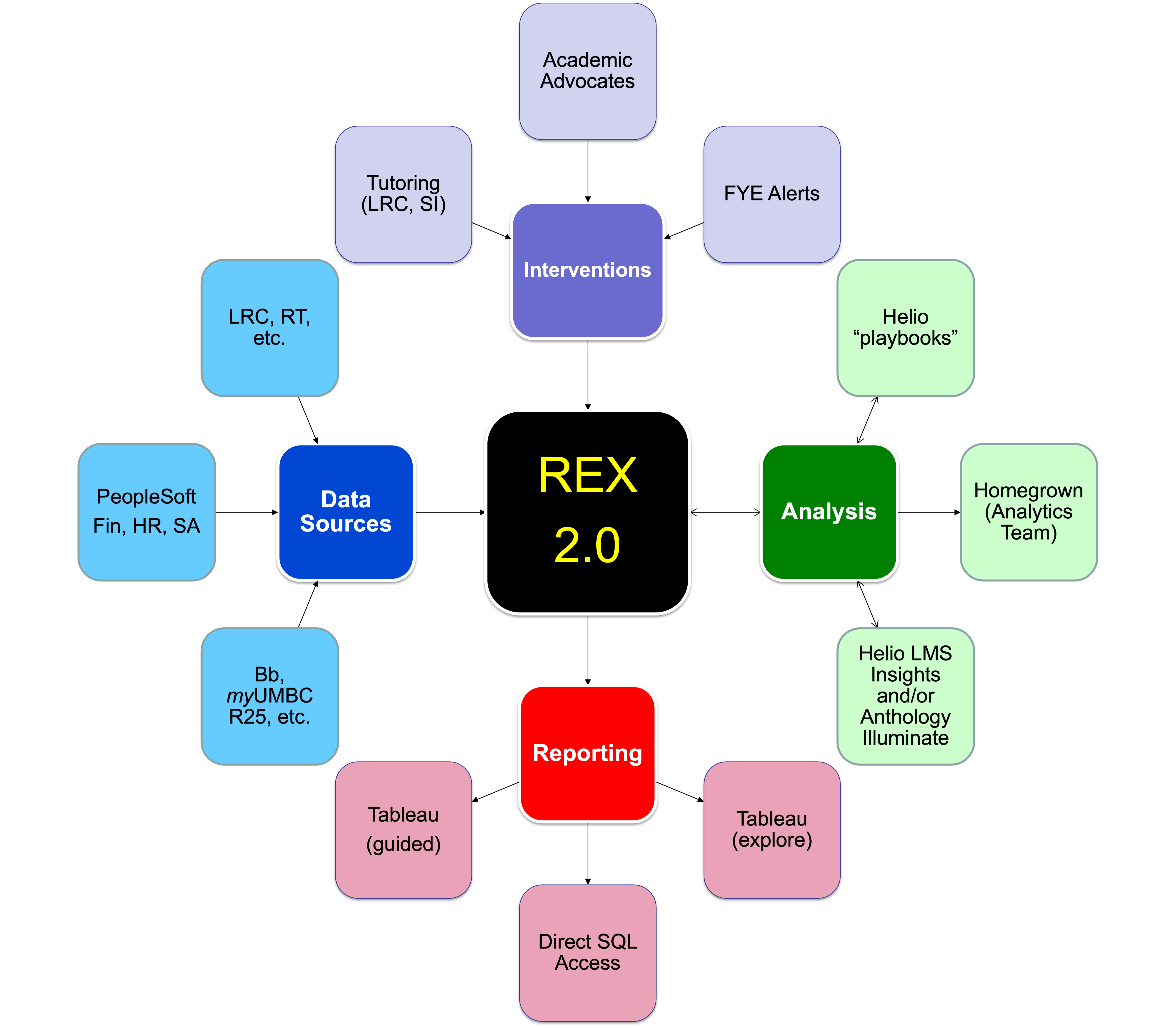
UMBC’s Report Exchange (REX) refers to the campus data warehouse, consisting of multiple data sources, reporting tools, analytics solutions and intervention outcomes. REX integrates data from administrative ERP systems and other data sources around campus, including student data, finance data, HR data, Blackboard data, etc. REX provides operational reporting to academic departments and administrative back offices. It is a platform for IR to provide census reporting to internal and external customers. The goal of REX is to make data available to decision makers for query, analysis, and reporting.
History
REX is the name of UMBC’s campus-wide reporting and decision support system. The name originated as a nickname for the “Report EXchange”. The “Exchange” referring to the idea of report development being decentralized more and users able to share reports with each other. It also plays well to the UMBC mascot, the Chesapeake Bay retriever. It should be noted that “Retriever” was already taken.
The UMBC data warehouse began in 2003, during the implementation of a new ERP system. It was built and used by the Office of Institutional Research. The implementation of the PeopleSoft HR system required a new system for IR to use HR data. From the beginning, the data warehouse has included legacy IR data along with the new PeopleSoft data. This implementation was run in an Oracle database and reporting done only by IR with Crystal and SAS.
In 2006, UMBC purchased a data warehouse from iStrategy. The iStrategy data warehouse was designed to be sourced from the PeopleSoft Student Admin (SA) module, which UMBC was just beginning to implement. Prior to SA going live, UMBC’s legacy data was “converted” to look like PS data in iStrategy. This allowed UMBC to get a head start on the future of their SA reporting, using legacy student data. This head start was beneficial for the users and developers, and turned data warehousing from an abstract idea to a tangible product. Because the iStrategy product only ran on Microsoft SQL Server, the implementation also involved the migration from our Oracle database to SQL Server 2005.
In Summer 2009, UMBC went live with PeopleSoft SA. The data warehouse was already in production and had a mix of legacy and PS data. The goal for the data warehouse has always been to have the operational data co-exist with the IR frozen data. In 2009, operational student data was available and the freeze for IR usage was done in the data warehouse. The legacy frozen student data would require a conversion effort and become available later. The student go-live in Summer 2009 was also the opportunity to give this puppy a new name and rebrand it from iStrategy to REX.
Early in 2011, Blackboard acquired iStrategy and renamed the product line, Blackboard Analytics (BbA).
Spring 2011, UMBC begins beta testing the BbA module for PeopleSoft Financial Aid
Fall 2011, UMBC begins beta testing the BbA module for PeopleSoft Finance
January 2012, UMBC migrates the Student Admin module to BbA version 4.0
January 2013, the REX web site is born and the data warehouse is upgraded to SQL Server 2012
More to come
Subject Areas
The following subject areas are available in the data warehouse
- Student Administration
- Admissions (Graduate and Undergraduate)
- Registration
- Course Scheduling
- Advising
- Financial Aid
- Student Financials (Billing)
- Human Resources
- Faculty/Staff
- Payroll
- Finance
- General Ledger
- Projects and Grants
- Institutional Research
- Cohort and Retention
- National Student Clearinghouse
- Blackboard
- RT (help desk ticketing system)